.png)
A-level Course
UK High School Curriculum(General Certificate of Education Advanced Level)
01. What is A-Level?
The A-Level (Advanced Level) qualification is traditionally regarded by many countries as the “gold standard” for post-16 education, particularly in countries with historical ties to the United Kingdom, where the examination originated. Although the A-Level qualification is a British curriculum designed for students aged 16 and above, many schools around the world offer A-Level programmes, and it is widely recognised as a qualification for entry into higher education institutions in the UK and many other countries globally.
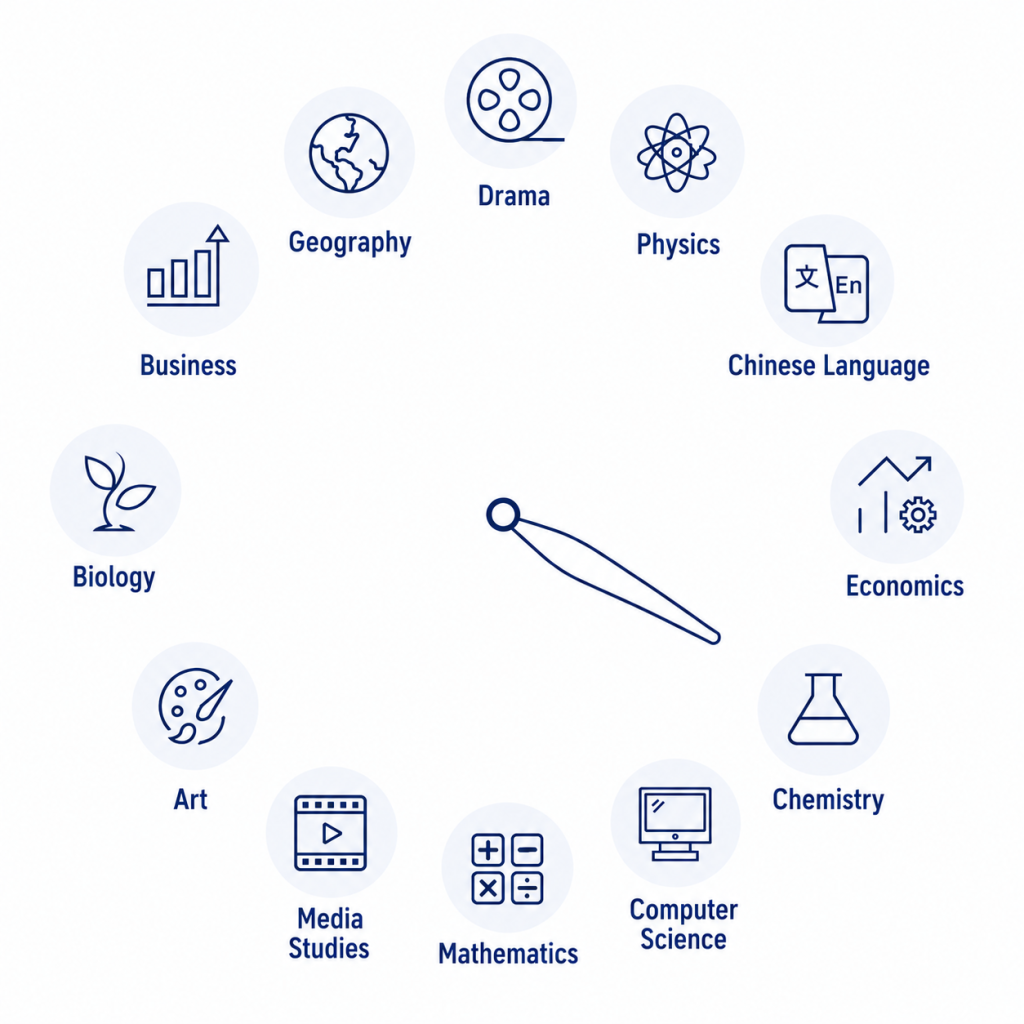
Students studying A-Levels typically take 3 to 4 subjects over a two-year period. Universities generally require students to have studied at least 3 A-Level subjects for admission, and the vast majority of students do indeed study three subjects. Unlike the IBDP, the A-Level curriculum has no compulsory subjects or fixed subject combinations. Students tend to specialise in certain subjects or study similar types of subjects, such as humanities (e.g., History, Geography, Economics) or sciences (e.g., Mathematics, Physics, Chemistry).
The subject combinations chosen by students are usually determined by their interests or the field they intend to pursue in the future. For example, Mathematics and Physics are typically A-Level subjects for students planning to study Engineering at university. Admission to humanities programmes at universities often has less stringent prerequisite requirements for A-Level subjects.
02. Advantages of A-Level
1. Specialised Learning
• In-depth Study: Students generally focus on only 3 to 4 subjects, which facilitates deep learning and the establishment of a specialised knowledge framework. This focus allows students to delve into their chosen disciplines and develop expertise.
• Flexible Subject Choices: Students can select subject combinations based on their interests and career goals. For instance, Mathematics, Physics and Chemistry suit Engineering, while History, Politics and Economics suit Social Sciences.
2. Global Recognition
• University Admission Standards: A-Level results are accepted by many prestigious universities worldwide, especially in countries such as the UK, Australia, Canada and Singapore. High A-Level scores can help students gain admission to top universities.
• Academic Reputation: The A-Level curriculum is renowned for its academic rigour, demonstrating students’ academic capabilities and potential.
3. Development of Key Skills
• Critical Thinking: The curriculum emphasises the cultivation of analytical, evaluative and critical thinking skills.
• Self-Management: Due to the depth and breadth of the curriculum, students need to develop strong time management and self-discipline skills.
03. How to Choose A-Level Subjects and Official Accreditation
The A-Level syllabus, curriculum structure and examinations are primarily designed and organised by authoritative British examination boards, namely Cambridge Assessment International Education (CAIE) and Edexcel.
As a globally recognised “gold standard education system”, its authority is widely acknowledged internationally. To date, over 5,000 educational institutions worldwide have offered the UK high school curriculum. Due to its scientific rigour and authority, Singapore has directly adopted it as the national unified examination for university entrance, and Hong Kong has also widely introduced this curriculum as an important testing standard for university admission.
Official Examination Centre Accreditation
Our school has been officially authorised by the British Edexcel examination board and possesses independent and comprehensive on-site examination centre qualifications.
Official Edexcel Centre Number: 98739
04. Who is A-Level Suitable For?
1. Students with clear academic direction
• Clear career goals: Suitable for students with a clear vision of their future career, allowing them to choose subject combinations relevant to their profession.
• Strong subject interest: Suitable for students with a strong interest in specific subjects who wish to study them in depth.
2. Students with strong self-directed learning ability
• High self-discipline: Suitable for students with good self-management and learning capabilities.
3. Students aiming for specific universities
• Clear target universities: Suitable for students planning to apply to universities in the UK and other institutions that recognise A-Level results.
05. St. Hilary’s Secondary School (Shenzhen) A-Level Subject Pathways and University Destinations
| Pathway | Recommended Subject Combination | Suitable Degree Programmes |
|---|---|---|
| Engineering / Computer Science | Mathematics + Further Mathematics + Physics + (Chemistry / another suitable subject) | Engineering, Computer Science, Artificial Intelligence and related STEM programmes |
| Finance / Economics / Actuarial Science | Mathematics + Further Mathematics + Economics | Finance, Economics, Actuarial Science and related Business programmes |
| Natural Sciences / Materials Science | Mathematics + Physics + Chemistry | Physics, Chemistry, Materials Science and related Natural Sciences programmes |
| More Subject Pathways | Individual subject combinations are developed with guidance from the University Counselling Team according to each student’s target universities and degree programmes | Tailored pathways aligned with specific university and programme requirements |
Note:
Subjects offered and available combinations are subject to the school’s curriculum arrangements for each academic year.
University entry requirements vary by institution and programme. Applicants should refer to the latest information published on the official websites of their target universities.
.png)