DSE課程

香港中學文憑考試
Hong Kong Diploma of Secondary Education Examination

一、什麼是 HKDSE

  1. 香港中學文憑考試(HKDSE)是香港特別行政區政府教育局所推行的中學會考考試,取代了原有的香港中學會考(HKCEE)和香港高級程度會考(HKALE)。
  2. HKDSE 是香港的大學入學考試體系,兼具內地升學及國際認可(如英國 UCAS、澳大利亞、加拿大等),適合兼顧多元升學路徑的學生。
  3. HKDSE 強調學生全面發展,評覈方式多元化,兼顧知識、能力及態度。

二、HKDSE 有什麼優勢

  1. 靈活性強
  • 設有多個選修科目,學生可依興趣和專長選擇。
  • 可以同時應考香港中學文憑考試和其他國際考試,如 SAT、AP。
  1. 評覈全面
  • 筆試、專題研習、術科表演等多元評覈方式。
  • 重視學習歷程,培養批判性思維和解決問題能力。
  1. 國際認可度高
  • 被多個海外大學和機構認可爲入學資格。
  • 爲學生打開國際升學和就業的大門。

三、HKDSE 的課程結構

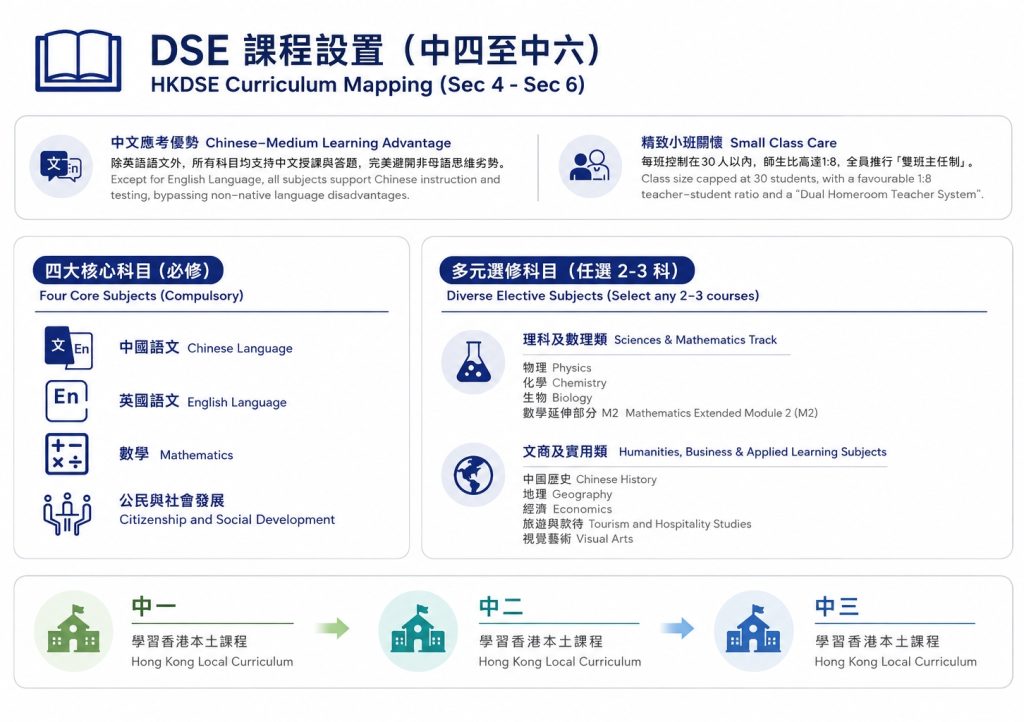
  1. 4 門核心科目:
  • 中國語文、英國語文、數學、公民與社會發展(原通識教育科,2024 年改革)。
  1. 20+ 選修科目(2-3 科,至多 8 科):
  • 涵蓋理科(物理、化學、生物)、文科(中國歷史、地理)、商科(經濟、企業會計)、藝術與科技等。
  1. 其他語言科目:
  • 法語、日語等(可作為選修或替代中文科)。

四、HKDSE 與其他國際課程對比

五、DSE 等級描述

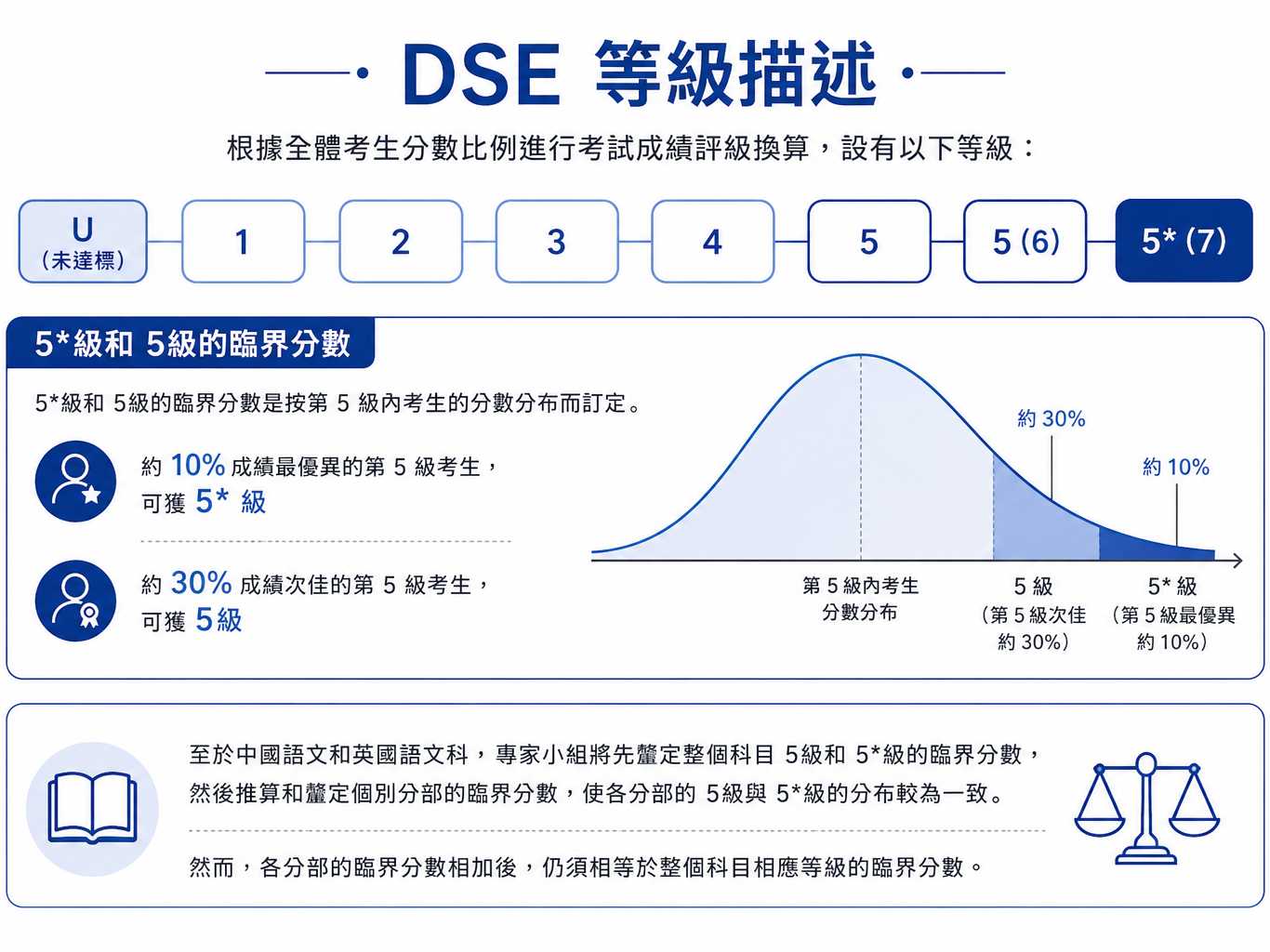
  1. 根據全體考生分數比例進行考試成績評級換算,設有以下等級:
    U(未達標) 1 2 3 4 5 5(6) 5*(7)
  2. 5*級和 5級的臨界分數
  • 5*級和 5級的臨界分數是按第 5 級內考生的分數分布而訂定。
  • 其中,約 10%成績最優異的第 5 級考生,可獲 5*級,約 30%成績次佳的第 5 級考生,可獲 5級。
  • 至於中國語文和英國語文科,專家小組將先釐定整個科目 5級和 5級的臨界分數,然後推算和釐定個別分部的臨界分數,使各分部的 5級與 5級的分布較為一致。
  • 然而,各分部的臨界分數相加後,仍須相等於整個科目相應等級的臨界分數。
  1. 不同級別的一般演繹
    (已包含英文原文,略)

六、国际认可度

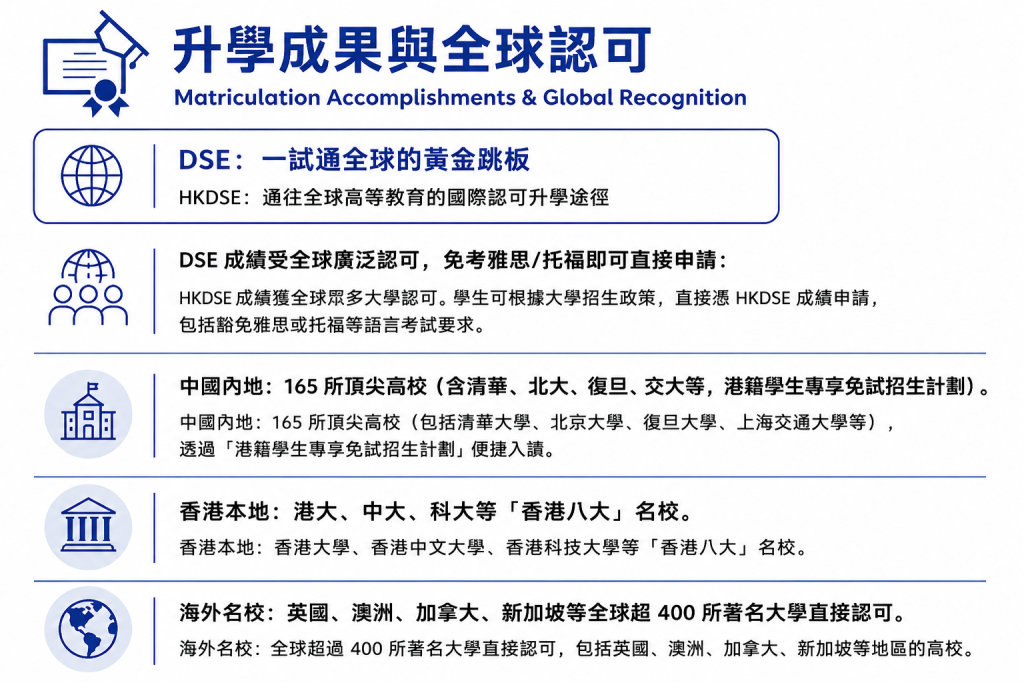
  1. HKDSE 被超過 150 個國家和地區的 1,300 多所大學及機構認可,包括:
  • 英国:牛津大学、剑桥大学、伦敦大学学院等
  • 美国:常春藤联盟(如哈佛大学、耶鲁大学)、加州理工学院、麻省理工学院等
  • 加拿大:多伦多大学、麦吉尔大学等
  • 澳洲:悉尼大学、墨尔本大学、澳洲国立大学等
  • 新加坡:新加坡国立大学、南洋理工大学等

根據香港考试及评核局的数据,在 2021 年,约有 30%的 HKDSE 毕业生获得海外名校录取。
其中:

  • 约 10%获得英国、美国等海外名校录取,如牛津大学、哈佛大学等。
  • 约 20%获得亚洲及其他地区的著名大学录取,如新加坡国立大学、东京大学等。

七、如何選擇適合孩子的 HKDSE 課程

  1. 暸解孩子的興趣和專長
  • 仔細思考自己最擅長和最感興趣的科目領域。
  • 評估自己的學習優勢和弱點,選擇能發揮所長的科目。
  1. 考慮未來發展規劃
  • 初步确定您希望在升学或就业时的方向。
  • 选择与您未来发展目标相关的核心科目。
  1. 制定合理的學習計劃和目標
  • HKDSE 设有必修和选修科目,要全面考虑。
  • 在必修科目上努力,同时根据兴趣选择适合的选修科目。
  1. 維持學科平衡
  • 避免過於集中在某一個領域,應保持科目的多樣性。
  • 選擇包括語文、人文、理工等不同範疇的科目。
  1. 諮詢他人意見
  • 與老師、學長、家長等討論,聽取他們的建議。
  • 兼顧專業意見和個人興趣,做出最合適的選擇。

八、如何更好地準備香港中學文憑考試

  1. 全面提高英語水平
  • 加強英語聽、說、讀、寫的訓練,全面提高英語綜合能力。
  • 多接觸英語資源,如英文書籍、電影、新聞等,培養語感。
  • 積極參與英語交流活動,提高溝通能力。
  1. 熟悉香港中學文憑考試英語考試要求
  • 仔細研讀香港中學文憑考試英語科目的考試大綱和評分標準。
  • 暸解各部分試卷(如閱讀、寫作、聆聽等)的具體要求。
  • 做大量香港中學文憑考試歷年真題練習,提高應試技巧。
  1. 鍛鍊各項英語技能
  • 阅读:广泛阅读各类英文文章,提高语汇量和理解能力。
  • 写作:分析题目要求,组织思路,精心撰写文章。
  • 聆听:反复听取 HKDSE 模拟试题,熟悉考试形式和技巧。
  • 口语:进行模拟口试练习,提高表达流畅度和应变能力。
  1. 制定系統的備考計畫
  • 合理規劃備考時間,兼顧各部分考試內容。
  • 堅持每天練習,養成良好的學習習慣。
  • 適時尋求老師或同學的指導和交流。
  1. 考試時注意事項
  • 仔細閱讀題目要求,理解題意。
  • 合理安排時間,注重答案的邏輯性和完整性。
  • 保持良好的心態,發揮平時的學習效果。

九、HKDSE 毕业生的升学和就业情况如何

  1. 升学情况
  • 近 3 年 HKDSE 毕业生升读香港八大院校的比率超过 70%。
  • 近 3 年有超过 30%的 HKDSE 毕业生获得海外名校录取,如美国常春藤盟校、英国牛津剑桥等。
  • HKDSE 畢業生的平均大學入學分數高於其他香港本地考試。
  1. 就業情況
  • 根據香港特區政府統計,香港中學文憑考試畢業生的就業率位居本地考試前列。
  • 香港中學文憑考試畢業生能夠在金融、科技、教育等不同行業廣泛就業。
  • 香港中學文憑考試畢業生起薪點和晉升空間優於其他本地考試。

HKDSE (Hong Kong Diploma of Secondary Education)

I. What is the HKDSE?

1.The Hong Kong Diploma of Secondary Education (HKDSE) is a public examination administered by the Education Bureau of the Hong Kong Special Administrative Region Government. It has replaced the former Hong Kong Certificate of Education Examination (HKCEE) and the Hong Kong Advanced Level Examination (HKALE).

2.The HKDSE constitutes Hong Kong’s higher education entrance examination framework. It is recognized both by Mainland Chinese universities and internationally (such as UCAS in the United Kingdom, universities in Australia, Canada, etc.), making it suitable for students pursuing diverse academic pathways.

3.The HKDSE emphasizes students’ all-round development and employs diversified modes of assessment, focusing on knowledge, competence, and personal attributes.

II.What are the advantages of the HKDSE?
1.High flexibility

  • Offers a wide spectrum of elective subjects, enabling students to select according to their interests and strengths.
  • Students may concurrently sit the HKDSE and other international examinations, such as SAT and AP.
  1. Comprehensive evaluation
  • Incorporates written papers, project-based learning, and performance/practical assessments.
  • Places emphasis on the learning process, fostering critical thinking and problem-solving capabilities.
  1. High international recognition
  • Accepted as an admission qualification by numerous overseas universities and institutions.
  • Provides access to international academic opportunities and career pathways.

III. Curriculum structure of the HKDSE

  1. Four core subjects:
  • Chinese Language, English Language, Mathematics, and Citizenship and Social Development (previously Liberal Studies, reformed in 2024).
  1. More than 20 elective subjects (students typically take 2–3 subjects, with a maximum of 8):
  • Including sciences (Physics, Chemistry, Biology), humanities (Chinese History, Geography), business-related subjects (Economics, Business, Accounting), as well as arts and technology.
  1. Other language subjects:
  • French, Japanese, etc. (may be chosen as electives or as substitutes for Chinese Language).

IV. Comparison with other international curricula

V. Grading descriptors for the HKDSE

  1. Performance is reported in levels determined by the distribution of candidates’ scores: U (Unclassified), Level 1–5, 5* (comparable to Level 6), and 5** (comparable to Level 7).
  2. Cut-off scores for Levels 5* and 5**
  • The thresholds for 5* and 5** are determined within the distribution of Level 5 candidates’ marks.
  • Approximately 10% of the highest-performing Level 5 candidates are awarded 5*, and about 30% of the next highest-performing candidates are awarded 5.
  • For Chinese Language and English Language, expert panels first establish the cut-off marks for the entire subject at 5* and 5**, then extrapolate them to individual components for consistency.
  • However, the sum of the cut-off marks across components must align with the overall cut-off score for the subject.
  1. Descriptors of performance levels
    (Already included in bilingual form in the original text.)

VI. International recognition

  1. The HKDSE is recognized by more than 1,300 universities and institutions across over 150 countries and regions, including:
  • United Kingdom: University of Oxford, University of Cambridge, University College London, etc.
  • United States: Ivy League universities (such as Harvard University, Yale University), California Institute of Technology, Massachusetts Institute of Technology, etc.
  • Canada: University of Toronto, McGill University, etc.
  • Australia: University of Sydney, University of Melbourne, Australian National University, etc.
  • Singapore: National University of Singapore, Nanyang Technological University, etc.

According to the Hong Kong Examinations and Assessment Authority (HKEAA), in 2021, approximately 30% of HKDSE graduates were admitted to prestigious overseas universities. Among them:

  • About 10% were admitted to leading institutions in the UK and the US, such as Oxford and Harvard.
  • About 20% were admitted to distinguished universities in Asia and other regions, such as the National University of Singapore and the University of Tokyo.

VII. How to choose the right HKDSE curriculum for your child

  1. Understand the child’s interests and strengths
  • Reflect carefully on the subjects in which the student excels and enjoys.
  • Assess academic strengths and weaknesses to select subjects that maximize potential.
  1. Consider future academic and career planning
  • Identify preliminary directions for higher education or employment.
  • Select core subjects aligned with long-term goals.
  1. Formulate a reasonable study plan and objectives
  • The HKDSE comprises compulsory and elective subjects; both must be considered holistically.
  • Work diligently in core subjects while selecting electives suited to personal interests.
  1. Maintain subject balance
  • Avoid excessive concentration in a single discipline; maintain diversity across subjects.
  • Include languages, humanities, sciences, and technology.
  1. Seek advice from others
  • Consult teachers, senior students, and parents for insights.
  • Balance professional guidance with personal interests to make optimal decisions.

VIII. How to prepare effectively for the HKDSE

  1. Enhance English proficiency comprehensively
  • Strengthen listening, speaking, reading, and writing skills.
  • Engage with English resources such as books, films, and news to cultivate language sense.
  • Actively participate in English communication activities to improve fluency.
  1. Familiarize yourself with HKDSE English examination requirements
  • Study the syllabus and marking criteria carefully.
  • Understand the specific requirements of each paper (reading, writing, listening, etc.).
  • Practice extensively using past examination papers to refine examination skills.
  1. Develop all aspects of English skills
  • Reading: Read widely across genres to expand vocabulary and comprehension.
  • Writing: Analyze prompts, organize ideas, and craft essays meticulously.
  • Listening: Repeatedly practice with HKDSE mock listening tasks to gain familiarity.
  • Speaking: Engage in oral mock examinations to enhance fluency and adaptability.
  1. Devise a systematic study plan
  • Allocate study time rationally across all subject areas.
  • Maintain daily practice and cultivate disciplined study habits.
  • Seek timely guidance from teachers and peers.
  1. Examination tips
  • Read questions carefully and ensure precise understanding.
  • Manage time effectively, ensuring answers are logical and complete.
  • Maintain composure and confidence to perform to full potential.

IX. Academic progression and employment outcomes of HKDSE graduates

  1. Academic progression
  • Over the past three years, more than 70% of HKDSE graduates progressed to Hong Kong’s eight publicly funded universities.
  • More than 30% gained admission to prestigious overseas universities, such as Ivy League institutions in the US and Oxford and Cambridge in the UK.
  • HKDSE graduates’ average university entrance scores surpass those of other local examinations.
  1. Employment outcomes
  • According to statistics from the Hong Kong SAR Government, the employment rate of HKDSE graduates ranks among the highest for local examinations.
  • Graduates secure positions across diverse industries including finance, technology, and education.
  • Starting salaries and career advancement opportunities for HKDSE graduates are generally superior compared to graduates of other local examinations.

深圳市德萃港人子弟學校 版權所有 2025-2026

粤ICP备2024242364号-1